
Reviewed · ÉVORA DAY TRIPS
Évora: Private walking tour with tickets to main monuments
Évora works because it is packed with layers. This private walking tour strings Roman power, Portuguese Gothic scale, and Renaissance ambition into one clear route you can follow on foot. I love that you get entry tickets to the Cathedral and Chapel of Bones, so you spend your time looking up, not figuring out logistics. I also love the street-level way the guide links places to Portuguese history. One possible drawback to plan around: you are on old cobblestones for about 2 hours 30 minutes, so comfy shoes help.
Because it is private, guides like João, Elsa, Paulo, and John (based on past bookings) tend to keep things interactive. You can ask questions, steer the conversation to what you care about, and usually get practical advice like where to eat afterward.
Key things you’ll appreciate on this Évora walk
- Cathedral access built in, including cloisters and a roof viewpoint
- Chapel of Bones tickets included, with real context behind the macabre effect
- A Roman-to-Renaissance route that feels chronological without being boring
- UNESCO core orientation fast, starting at the city’s main square
- More than the big sights, including quieter stops like Pátio de São Miguel
- A relaxed private pace, designed for questions and adjustments
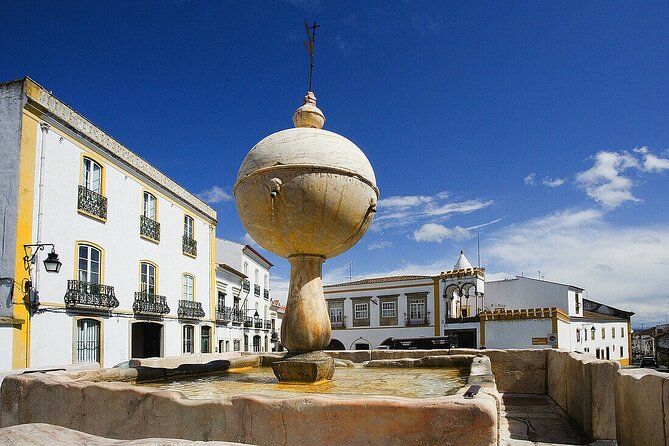
Start at Praça do Giraldo, then watch Évora’s story click into place
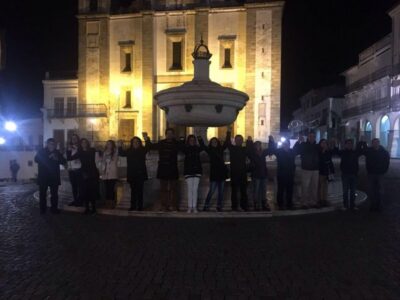
Most people walk into Évora and feel overwhelmed fast. This tour starts where locals do: Praça do Giraldo, the heart of the city. It is the central gathering spot, and since Évora became a UNESCO World Heritage city in 1986, this plaza has also been the natural “welcome mat” for the whole historic center.
From here, you get a framework for what you are seeing. The guide places Évora in the long story of Portugal and universal history, which matters because the monuments here do not exist in isolation. They are answers to past rulers, shifting faith, trade routes, and defensive needs.
Right nearby is a tougher stop: a remembrance connected to the Inquisition in Portugal. The Inquisition dates from 1536 and lasted nearly 300 years. In Évora, this period is tied to Praça do Giraldo as the place where many victims were burned alive, and the court in Évora is described as the deadliest among the four that existed in Portugal. You can treat this as a short but serious history lesson, then move on with a clearer understanding of why some spaces look the way they do.
After that, you shift gears to the everyday side of Évora: the city’s traditional commerce street. This is where you can browse Alentejo crafts like cork objects, pottery, painted furniture, rattles (chocalhos), and traditional cloaks (capotes). Even if you do not buy anything, it helps to see how the historic city keeps producing culture now, not just in museum rooms.
More Évora day trips:
- Évora and Megaliths Full-Day Tour from Lisbon
★ 4.7 · 456 reviews - Évora and Monsaraz with Regional Wine Tasting from Lisbon
★ 4.5 · 229 reviews - Évora (with Sé & Bones), Evoramonte & Arraiolos: From Lisbon
★ 4.7 · 57 reviews
Se Catedral de Évora: Gothic scale plus cloisters and roof views
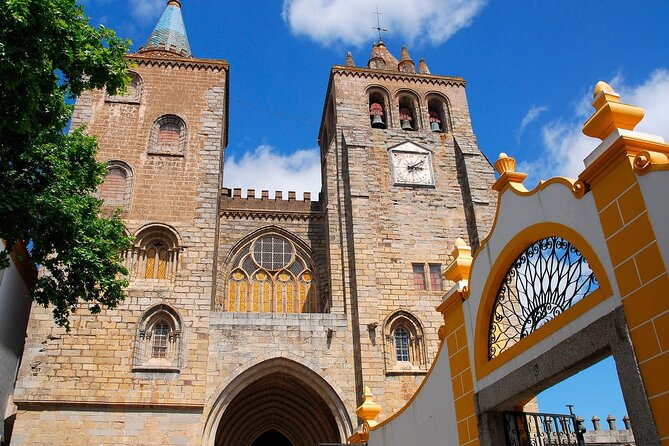
Next comes the big one: Se Catedral de Évora, often highlighted as the largest Portuguese Gothic cathedral. The tour includes your entrance ticket, and that is a smart deal because you are not just looking at the outside.
Inside, you get time for:
- The cathedral itself
- The cloisters
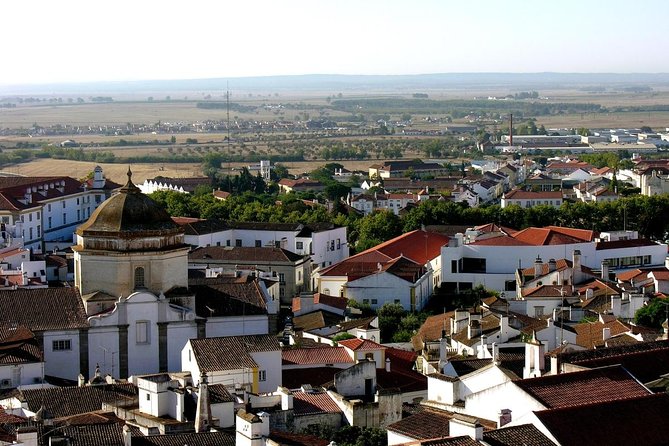
- The roof visit for a panoramic view over Évora
Two details make this stop feel different from a standard cathedral visit. First, the cathedral was built along lines compared to the famous Notre Dame de Paris. Second, you are told it contains references that you might not expect in a Catholic temple, including secret messages and allusions to earlier pagan cults. Even if you do not track every symbol perfectly, that framing changes how you read the building.
Time-wise, plan on around 30 minutes here. That is enough to see the main features without feeling rushed, especially because this is private. If you care about architecture, this is the moment to slow down and ask what to notice.
Templo Romano de Évora: 2,000 years of power in one stop
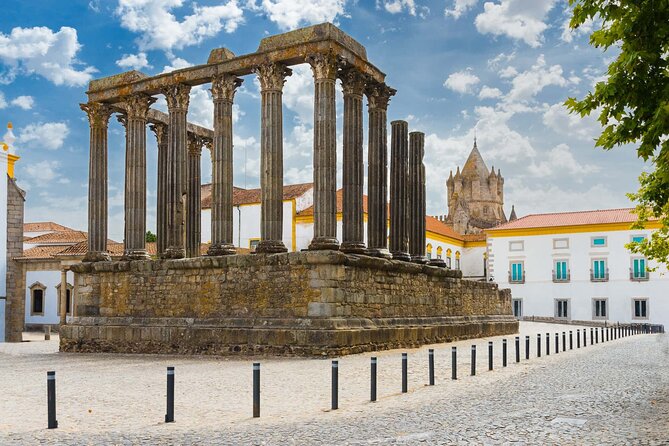
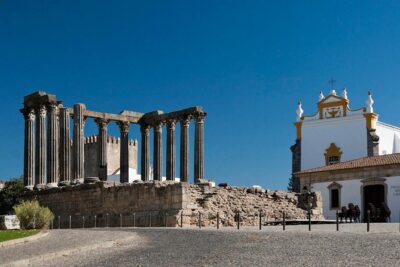
After Gothic grandeur, you jump back to Roman times with Templo Romano de Évora, also known as Templo de Diana. The tour keeps this short, around 10 minutes, which is good because it lets you catch the big idea without turning the day into a checklist.
This temple is described as one of the best preserved and oldest in the ancient Roman world. It is positioned as an emblem of Roman power and connected to the ancient city founded by Júlio César. On a walking tour, this stop works best when you treat it like a snapshot. Look at how it anchors the older layer of Évora, then notice how the later buildings and defenses grew around older footprints.
If you like history that shows up in stone, you will appreciate how easily this monument fits into the rest of the route.
Pátio de São Miguel: a quiet courtyard tied to rulers and orders
One of my favorite patterns in Évora is how the most interesting places can feel slightly off the main street. Pátio de São Miguel is a good example. It is described as one of the most beautiful spots in Évora, but also a little missed by tourists because it is tucked away.
This is not just pretty architecture. It is presented as an ancient alcove that was heavily fortified. It also connects to power: it served as home to the city governor and a privileged place for old kings when they were in Évora. For art history fans, it is tied to the religious and military order that later became the Order of Avis, linked to the second Portuguese dynasty of kings.
Time is about 10 minutes, and you should treat it like a pause. Let the calm break between larger monuments sink in, then carry the “power and protection” theme forward into what comes next.
More walking tours in Lisbon:
- Lisbon: History, Stories and Lifestyle Walking Tour
★ 4.8 · 10,902 reviews - Best of Lisbon Small-Group Guided Walking Tour
★ 5.0 · 4,869 reviews - Lisbon: Food and Wine Small Group Walking Tour
★ 4.9 · 4,082 reviews - Best of Lisbon Walking Tour: Rossio, Chiado & Alfama
★ 4.9 · 2,700 reviews
Mannerist and Renaissance hits: Igreja da Graça and the fountain tied to Cardinal D. Henrique
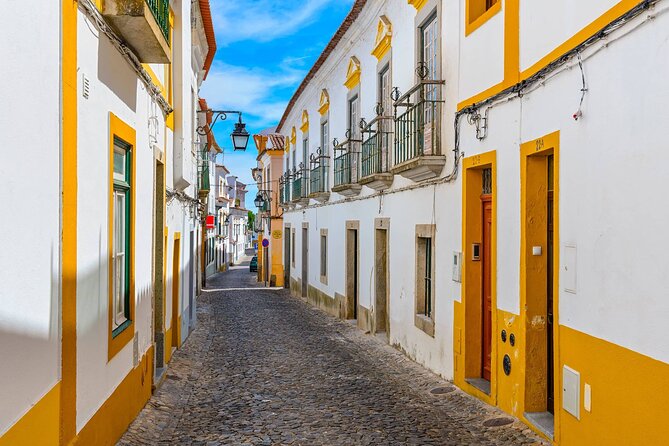
Évora’s Renaissance side shows up in two ways here: religious architecture and public power.
First, you visit Igreja da Graça, described as a larger example of Portuguese Renaissance architecture with innovative elements inspired by Mannerism. You are also told about the famous “boys” of Graça, plus the symbolic meaning of the beautiful facade of the old hermitage. Those are the kinds of details that matter, because they turn a church facade from decoration into a story you can read.
Right after or alongside that theme, you get the fountain stop tied to early Mannerist art in Portugal. It was inaugurated in 1556 and is described as a major example of Portuguese urban architecture. It is connected to Cardinal D. Henrique, described here as a great patron of Évora and the last king of the Avis dynasty. That is an easy concept to miss if you only take a photo, but the guide’s context makes the fountain feel like a political marker, not just water.
These stops are short, around 10 minutes each, which makes sense for pacing on a walking tour. They are designed to add variety while still keeping the story moving.
Chapel of Bones: macabre, but framed as cultural history
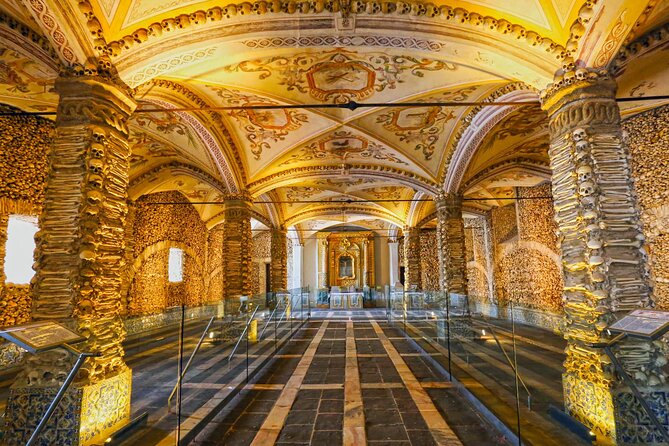
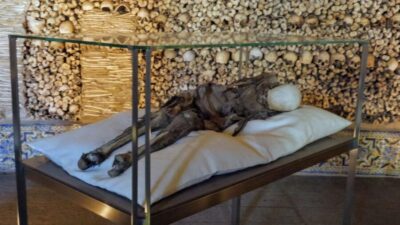
This is the stop that most people either love or fear. Capela dos Ossos (Chapel of Bones) is described as unique in the world for its size and one of the most macabre monuments you will see in Portugal. Its walls are covered with real human bones that belonged to thousands of people who lived in Évora, and it was built in the 17th century.
The tour includes your entrance, with about 30 minutes here. I like that the presentation is not just shock value. It is set up as a place with secrets and legends the guide shares, so you can understand the cultural meaning behind the look.
When you walk in, you are met with a warning-style message. The phrasing is something like We, the bones that are here, await yours. If you are worried about it being creepy, you can still go in with a mindset of “why did people do this?” That question makes the experience more meaningful and less scary.
Igreja de São Francisco and the royal convent stories
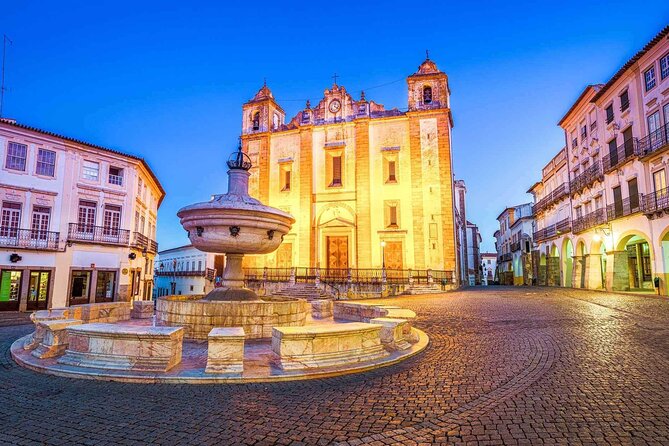
Next is Igreja De Sao Francisco, known in the 16th century as the golden convent. The guide frames it as an architectural work that was innovative for its time. It also sits on top of an older Franciscan convent from the 14th century.
This is a good stop for anyone who likes how buildings track real life events. You are told it was a royal church and a scene for royal weddings and baptisms that changed the course of Portugal and even the wider world. Even if you know little about Portuguese royal history, the tour’s structure helps you connect the story to what you see.
Time here is about 10 minutes, so it is more about the big-picture impact than a slow museum-style visit.
Palacio de Dom Manuel and Ruínas Fingidas: romance, power, and quick photo breaks
After the church story, you shift to a palace-related stop: Palácio de Dom Manuel. What remains today is described as the Ladies’ Gallery, and it is framed as the most beautiful and romantic part of the ancient complex from the 16th century.
This is followed by Ruinas Fingidas, described as a romantic setting assembled with elements and ruins of a 16th-century palace. It is connected to late 19th-century romanticism, and you are basically encouraged to ask your guide to take a picture here. It is short, around 5 minutes, but it gives you a visual memory that feels different from the religious and defensive stops.
Muralhas de Évora and Aqueduto da Água de Prata: defensive walls and Renaissance water engineering
The tour ends with Évora’s power systems, both protective and practical.
You pass Muralhas de Évora, described as an impressive network of defensive walls spanning multiple eras:
- Roman walls from the 3rd and 4th century
- Later use by Visigoths and Muslims, who remained in the city between the 8th and 12th century
- Medieval walls from the 14th century
- Bastioned structures from the 17th century
- Reinforcement in the early 19th century to sustain French troops from the Napoleonic invasions
That timeline is a lot for one walking route, but the value is that you see how the city kept adapting its defenses as power shifted. You will likely start noticing the “why” behind different wall sections and shapes.
Then comes the final monument: Aqueduto da Água de Prata, the aqueduct of the Silver Waters. It is presented as the most iconic Portuguese civil work of the Renaissance and is described as opened in 1537. The extension is given as 18 km.
Even if you only see part of it up close, the tour highlights something helpful: the aqueduct’s detail work and how houses are inserted between arches. That combination of engineering and urban life is what makes it feel like a real city milestone, not just a standalone structure. Time here is around 5 minutes, so focus on the arches and the finer visual details the guide points out.
Price and tickets: does $105.26 per person feel fair?
At $105.26 per person for a tour around 2 hours 30 minutes, the value comes down to three things you actually get on the ground.
First, you get included entrance fees for the Cathedral and the Chapel of Bones. Those are two of the most ticket-requiring stops on the route, and they are also the stops you will care about most. If you had to arrange entrances separately, you would lose time and mental energy, especially in a compact historic center.
Second, this is a private walking tour with only your group. That matters for a city like Évora, where you may want to ask follow-up questions, pause for photos at places like Ruínas Fingidas, or slow down for architecture. Past feedback highlights that guides can tailor the pace to what you care about.
Third, you do not have to plan meals here. Meals are not included, which is honest and useful. You can decide where you want to eat based on the type of day you want, and many guides are in a position to suggest a dinner option that fits the neighborhood you are in.
One note: the tour is offered in English, and it uses a mobile ticket. If you prefer having everything on your phone, that is a plus.
Who should book this private Évora walking tour
This is a great match if you want:
- A first-time orientation to Évora’s UNESCO core without guessing the order of stops
- Architecture and art history you can understand, not just see
- A guided route that connects Roman, Gothic, Mannerist, and Renaissance threads into one walk
- A conversation-based experience where you can ask questions and get straight answers
You might think twice if you hate walking on uneven old streets, since the tour is built around a moderate fitness level and a dense set of sights in a short window.
Should you book Évora Cultural Experience?
Book it if you want the key monuments plus the context to make them click. The Cathedral and Chapel of Bones tickets are already part of the experience, and the route is built to keep momentum while still hitting quieter stops like Pátio de São Miguel.
If your travel style is strictly self-guided and you prefer to wander without structure, you might be tempted to DIY Évora. But if you like your monuments explained while you are standing in front of them, this private format is a strong choice.
One practical timing tip: this tour is commonly booked about 52 days in advance, so if you have fixed travel dates, lock it in early. You will start at Praça do Giraldo 7, and the experience ends back at the meeting point, so it is easy to build the rest of your day around it.
FAQ
What sites are included in the tour tickets?
The tour includes entrance fees for the Chapel of Bones and the Cathedral.
How long is the private walking tour in Évora?
It runs about 2 hours 30 minutes.
Is this tour private or group-based?
It is a private tour/activity, so only your group participates.
What language is the tour offered in?
The tour is offered in English.
Where does the tour start and end?
It starts at the Giraldo Square Fountain at Praça do Giraldo 7, 7000-508 Évora, Portugal, and ends back at the meeting point.
Is the tour suitable for people with limited mobility or fitness?
The tour notes a moderate physical fitness level. It is a walking tour, so comfortable shoes help.
Are meals included in the price?
No, meals are not included.
Is free cancellation available?
Yes. You can cancel up to 24 hours in advance for a full refund. If you cancel less than 24 hours before the start time, the amount paid will not be refunded.
Newly reviewed in Lisbon
- Lisbon: Private Food Tour – 10 Tastings with Locals★ 4.8 · 73 reviews
- Lisbon: Private Custom Tour with a Local Guide★ 5.0 · 6 reviews
- Lisbon: 2 hours Private City Highlights Tuk-Tuk Tour for two★ 5.0 · 5 reviews
- Lisbon: City Sightseeing Tour★ 4.9 · 13 reviews
- Lisbon: Private Christmas Lights Tour by Eco Tuk Tuk★ 4.9 · 51 reviews
- Lisbon: Private Catamaran Charter for up to 18-People★ 5.0 · 7 reviews
- Lisbon: Private Boutique Boat Tour – Sail in Style★ 5.0 · 87 reviews
- Lisbon: Private Boat Trip, Guided Walking Tour, Bike & Tram★ 4.8 · 116 reviews
Évora Day Trips, compared.

Évora and Monsaraz with Regional Wine Tasting from Lisbon
Read our review →
Private tour with entrance tickets to main monuments
Read our review →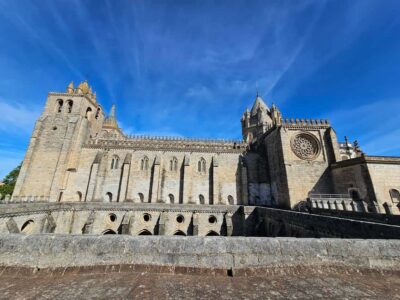
Évora (with Sé & Bones), Evoramonte & Arraiolos: From Lisbon
Read our review →
Evora University, Cathedral & Bones Chapel — SkipLine + Wine
Read our review →Browse the lists this tour appears in