Reviewed · GUIDED
Lisbon on foot: From the hills to the river – Dutch guide
Lisbon works best on foot, and this one is extra fun because you go hill to river with a Dutch-speaking guide who stitches the city together as you walk. You start with big views over the red roofs and São Jorge Castle, then you end near the water with the 25th of April Bridge in the story.
Two things I really like: you get clear Dutch explanations with no translation lag, and the route is built to keep moving, with smart stops like Café A Brasileira and a classic pastel de nata break.
One consideration, before you lace up, is that it is not suitable if you have mobility issues. This is a hilly walk with stairs and slopes, and you will be on your feet for the full 2 hours.
Key takeaways before you walk
- Dutch-only guidance means you hear the story straight from the guide, without secondhand explanations
- Hilltop to Tagus finish gives you a real sense of how Lisbon climbs and falls
- Café A Brasileira + Fernando Pessoa adds a cultural stop beyond the usual sightseeing
- Santa Justa Lift and Baixa help connect Lisbon’s neighborhoods to the city’s big rebuild after 1755
- 25 de Abril Bridge history lands naturally right when you’re in the right zone for the views
- Time Out Market is a convenient place to eat or drink after you’re done walking
Walking Lisbon in Dutch, from viewpoint to the river

I like tours that feel like a guided walk with a plan, not a checklist with a stopwatch. This one starts at the São Pedro de Alcântara viewpoint, with an option that can also be Miradouro de São Pedro de Alcântara, so you get your bearings early with a wide panorama.
What makes the Dutch format practical is simple: you are not constantly translating in your head. If you speak Dutch, or you’re comfortable with listening to Dutch at a basic tour level, the experience clicks. You can focus on the streets, the viewpoints, and the way the guide explains how Lisbon’s past connects to daily life right now.
The pace is described as relaxed, and the tour runs for about 2 hours. You will not be bouncing between distant points by bus. Instead, you’ll walk through the center, using Lisbon’s vertical shortcuts along the way, including the Santa Justa Lift area as you head down toward Baixa.
A few other ways to do Lisbon
- Best of Lisbon Small-Group Guided Walking Tour
★ 5.0 · 4,869 reviews - Lisbon: Private Guided Tuk-Tuk Tour with Hotel Pickup
★ 4.9 · 4,552 reviews - From Lisbon: Fátima, Nazaré, Batalha, and Óbidos Guided Tour
★ 4.7 · 3,060 reviews
São Pedro de Alcântara, where Lisbon’s big picture makes sense
This start point matters. São Pedro de Alcântara is one of those places where you immediately understand the city layout, and the guide can point out what you’ll be seeing later.
From the viewpoint, you get a clear look toward São Jorge Castle. Even if you do not go inside anything, seeing the castle in the background helps you understand why Lisbon is shaped the way it is, perched above the river and surrounded by hills.
Think of this as your mental map. By the time you leave the viewpoint, you’re not just wandering. You know you’re moving from the heights toward the Tagus River, and the guide’s stories will keep landing because your eyes have already taken in the bigger shape of the city.
Practical tip: bring your camera and use the viewpoint time well. In good weather, the light can make the city look almost layered, and it’s easier to capture the view before you head into narrower streets.
Bairro Alto and Chiado, where maritime stories fit the street plan
After the viewpoint, you head into Bairro Alto and Chiado, two areas that feel like Lisbon’s classic theater set: hills, stairways, street corners, and lots of old-world energy.
This is where the guide ties the city to Portugal’s maritime history and the Age of Exploration. Expect names like Vasco da Gama and Luís de Camões to come up, and the way the guide explains them helps the city feel less like postcard scenery and more like a place with a long public memory.
One underrated benefit of walking through neighborhoods like Bairro Alto and Chiado with a guide is that you notice the scale. Buildings feel different when you can see how people move between them, and you also start to understand why certain areas became important as trade and seafaring shaped Lisbon.
If you like stories that connect people, places, and time periods, this section usually does the heavy lifting.
Café A Brasileira and Fernando Pessoa, a break that feels like culture
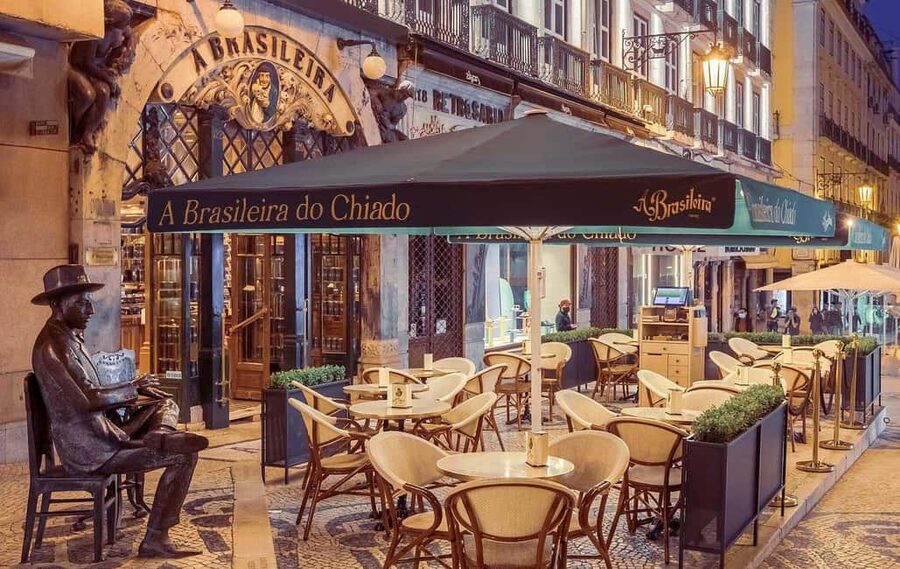
Soon you stop at Café A Brasileira, where you’ll be greeted by a statue of Fernando Pessoa. This is the kind of stop that makes a walking tour worth it, because it’s not just a landmark, it’s an entry point into how Portuguese writers and public life echo through everyday spaces.
Café stops on tours can be hit-or-miss. Here, the payoff is that the guide makes it more than a coffee break. You’re stopping in the middle of the walk, at a moment that fits the route as you transition downward toward Baixa.
You’re also building momentum. After this pause, the tour heads toward the Santa Justa Lift descent and the commercial heart of Lisbon, so your brain is ready for the next shift in scenery.
Another side of Lisbon for the same trip:
- Lisbon City Center Tour – The Unmissable Lisbon
★ 5.0 · 22,234 reviews - Lisbon: Sintra, Pena, Regaleira, Cabo da Roca & Cascais
★ 4.7 · 19,656 reviews - Lisbon: Jerónimos Monastery Entrance Ticket
★ 4.1 · 14,164 reviews - Lisbon: History, Stories and Lifestyle Walking Tour
★ 4.8 · 10,902 reviews
Descending to Baixa via Santa Justa Lift, Lisbon’s rebuild after 1755
Lisbon changes fast when you go from the hill neighborhoods into Baixa. The guide routes you down via the Santa Justa Lift, which also gives the walk a practical rhythm: you’re not just climbing and falling, you’re using the city’s own vertical transport.
In Baixa, the stories shift to Lisbon’s reconstruction after the great earthquake of 1755. This is important because it explains why parts of the city feel more ordered and planned compared to the older, twistier areas on the heights.
This section is also where a lot of people feel the value of a guide. Without one, you might see Baixa as just streets and shops. With the explanation, you notice the logic of the streets and understand why the city’s layout reflects a major turning point.
You’ll also have a break time here. It’s not described as a long pause, but it gives you a chance to reset before you continue.
Praça Luís de Camões, Carmo Convent, and St. Dominic’s Square

Between the big “bookends” of viewpoints and the Tagus, you pass through a cluster of named stops where you get guided orientation.
You’ll visit Praça Luís de Camões, then move through the Carmo Convent area and St. Dominic’s Square. The tour notes that you’ll get a guided tour at these points, so the guide uses these stops as story anchors.
What I like about this part of the route is that it prevents the walk from feeling random. Even if you are not going inside any attraction, you are still learning what to look at and why those places matter in Lisbon’s ongoing story.
If you’re the type who likes to understand why a square is named the way it is, or why a specific place feels like a focal point, these stops usually land well.
Commerce Square and the 25 de Abril Bridge, views with context
Next up is Commerce Square, Lisbon, a place that naturally ties into the river narrative. Even if you’ve seen photos, seeing it as part of a walk changes how it feels. You’re not looking at the square alone. You’re moving toward the water, so the river story stays in view.
Then comes the 25 de Abril Bridge. The tour explicitly focuses on learning about the bridge’s history, and along the way you’ll have scenic views. The best part is timing. You’re told the story and you see it from the right perspective, rather than hearing history as a random fact after you’re already done taking photos.
I also appreciate how this fits the theme of the tour. Lisbon is a city of edges: the land edge at the viewpoints, the street edge in the center, and then the strong river edge. The bridge is one of the most dramatic reminders of how Lisbon connects across water.
Don’t rush this section. If you speed through the bridge area, you miss why the guide brought you there.
Pastel de nata stop, the one food moment that breaks the pace
No one wants a walking tour to feel like you’re working out all the time. This tour keeps you moving, and it does not describe a long break during the walk.
Instead, there’s a tasty stop where you can have a pastel de nata, described as what the guide believes to be the best in the city. I like this approach because it’s not a food detour that steals an hour. It’s a small reward timed to keep you engaged.
A practical strategy: if you’re prone to decision paralysis with pastries, decide early that you will order a pastel de nata here and save other desserts for later at the end.
Time Out Market at Cais do Sodré, your easy post-walk plan
The tour finishes at Time Out Market. That ending is smart because it gives you an immediate place to eat or drink without planning anything last-minute.
Finishing at Cais do Sodré also makes sense for logistics. After 2 hours of walking and viewpoints, your legs will want a sit-down plan. Time Out Market is a natural place to do that, and you can choose what you feel like eating instead of committing to one fixed meal during the walk.
If you’re doing this as part of a longer day, you can also treat the finish point as a springboard. You can keep exploring afterward with full energy, or you can just call it and enjoy dinner somewhere nearby.
Price and value, what you pay for and what you get
The price is listed at $36 per person for a 2-hour walk. That sounds straightforward, but here’s how I think about value in cases like this.
You’re paying for three things:
- A Dutch-speaking guide who can deliver the city story without language friction
- A guided route that gets you from hills to the river in a logical flow
- Time-saving decisions, like using the Santa Justa Lift area and placing the food stop where it supports the pace
Also, no entrance fees are included, and the tour explicitly says you won’t go inside attractions. For me, that means the ticket value is all about interpretation and route design, not about museum time.
If you want a walk that gives you context and helps you see the city with better eyes, the price starts to look fair. If you specifically want indoor museum visits, you might feel like you’re missing part of the experience. But as a street-level orientation to Lisbon, this one punches above its weight.
Who this Lisbon walk suits best, and who should skip it
This tour is best for you if:
- You want a Dutch-language experience and don’t want to translate your way through a story
- You enjoy a route that connects viewpoints, squares, and neighborhoods into one clear theme
- You like learning how Lisbon’s bigger turning points, like the earthquake of 1755 and the meaning of the 25 de Abril Bridge, show up in the city today
You might skip it if:
- You need a tour in English or another language. It is Dutch only.
- You have mobility challenges. The tour notes it is not suitable for people with mobility impairments, likely because the route is hilly and includes walking on uneven streets.
- You want to maximize indoor sightseeing. This one is designed around walking and seeing, not entering sites.
One more point that came through strongly in guest feedback: people praised how the guide explained things in a fun way. If you like your facts delivered with energy and practical clarity, you’ll probably enjoy Gino’s style.
Should you book this Dutch Lisbon walk?
Book it if you want a smart, story-led walk that helps you understand Lisbon from the hills down to the Tagus, in Dutch, with memorable stops like Café A Brasileira, a pastel de nata pause, and a finish at Time Out Market. It’s a great “get your bearings fast” kind of tour, especially when you only have a couple of hours and you want the city to make sense.
Skip it if Dutch is a mismatch for you, or if you need a route that is easier on mobility. This is a walk first, and the payoff is the way the guide connects the city into one continuous experience.
FAQ
How long is the Lisbon on foot tour?
The tour lasts 2 hours.
What language is the tour guide speaking?
The tour is in Dutch.
How much does the tour cost?
The price is $36 per person.
Where does the tour start?
It starts at São Pedro de Alcântara viewpoint, with an option listed as Miradouro de São Pedro de Alcântara.
Where does the tour end?
The tour ends at Time Out Market.
Is there a break during the walk?
There is no break during the walk, but there is a tasty stop for a pastel de nata.
Are entrance fees included for attractions?
No. Entrance fees to attractions are not included, and the tour does not go inside attractions.
Is the tour suitable for people with mobility impairments?
No, it is not suitable for people with mobility impairments.
Do I need a pickup from my hotel?
Hotel pickup and drop-off are not included.
Is free cancellation available?
Yes, you can cancel up to 24 hours in advance for a full refund.
Newly reviewed in Lisbon
- Lisbon Hills secrets, soul and insights all in 1 TukTuk ride★ 5.0 · 55 reviews
- 4-hour Tuk Tuk Tour of Belém, City Center, and Lisbon’s Old Town★ 5.0 · 7 reviews
- 4 Hours Private Sailing Trip to Oeiras Beach★ 5.0 · 52 reviews
- Nazare,Obidos, and Batalha Monastery Private Tour★ 5.0 · 3 reviews
- 4 Hours Private Tuk Tuk Tour in Lisbon★ 5.0 · 15 reviews
- Private tour Portugal 4 days from Lisbon★ 4.5 · 3 reviews
- 3 Hours Private Tour of Lisbon’s Historic Center by Tuk Tuk★ 5.0 · 17 reviews
- 4-Day South Portugal Tour from Lisbon: Lagos, Algarve Coast, Sagres, Évora, Beja and Setúbal★ 3.5 · 8 reviews
Guided, compared.

Best of Lisbon Small-Group Guided Walking Tour
Read our review →
Private Guided Tuk-Tuk Tour with Hotel Pickup
Read our review →
Fátima, Nazaré, Batalha, and Óbidos Guided Tour
Read our review →
Guided Tour to Sintra, Pena, Regaleira, Cabo da Roca and Cascais
Read our review →
Welcome Lisbon Tour with Local Guide in Private Eco Tuk Tuk
Read our review →